
How much money is really in your bin?
A very common question I get is whether it’s worth it to focus on reducing trimmings and whether we can actually save money by reducing trimmings.
The big question is: How much money is really in your bin?
So here is some simple math:
If you were to calculate the average purchase price for your TOP20 most used fruit&veg, you would most likely get a number around 3€ per kilogram, as an average. It might be a bit more or less, but let’s stick to 3€ for the purpose of this example.
If you waste 20kg of trimmings and byproducts per day, you have 20 x 3€ = 60€ in a bin per day.
If you do this every single day in a year, you have 60€ x 365 days = 21,900€ in a bin per year.
But there is a problem with this example. Most big kitchens waste a lot more than only 20kg of trimmings in a day. Much more. 60kg per day is nothing unusual.
So if you have 60kg of trimmings in a bin every day, it becomes 65,700€ in a bin over a year.
More than 65,000€ in a bin, only on raw ingredients. Not even counting other types of food waste, such as overproduction or spoilage, or lost potential margin.
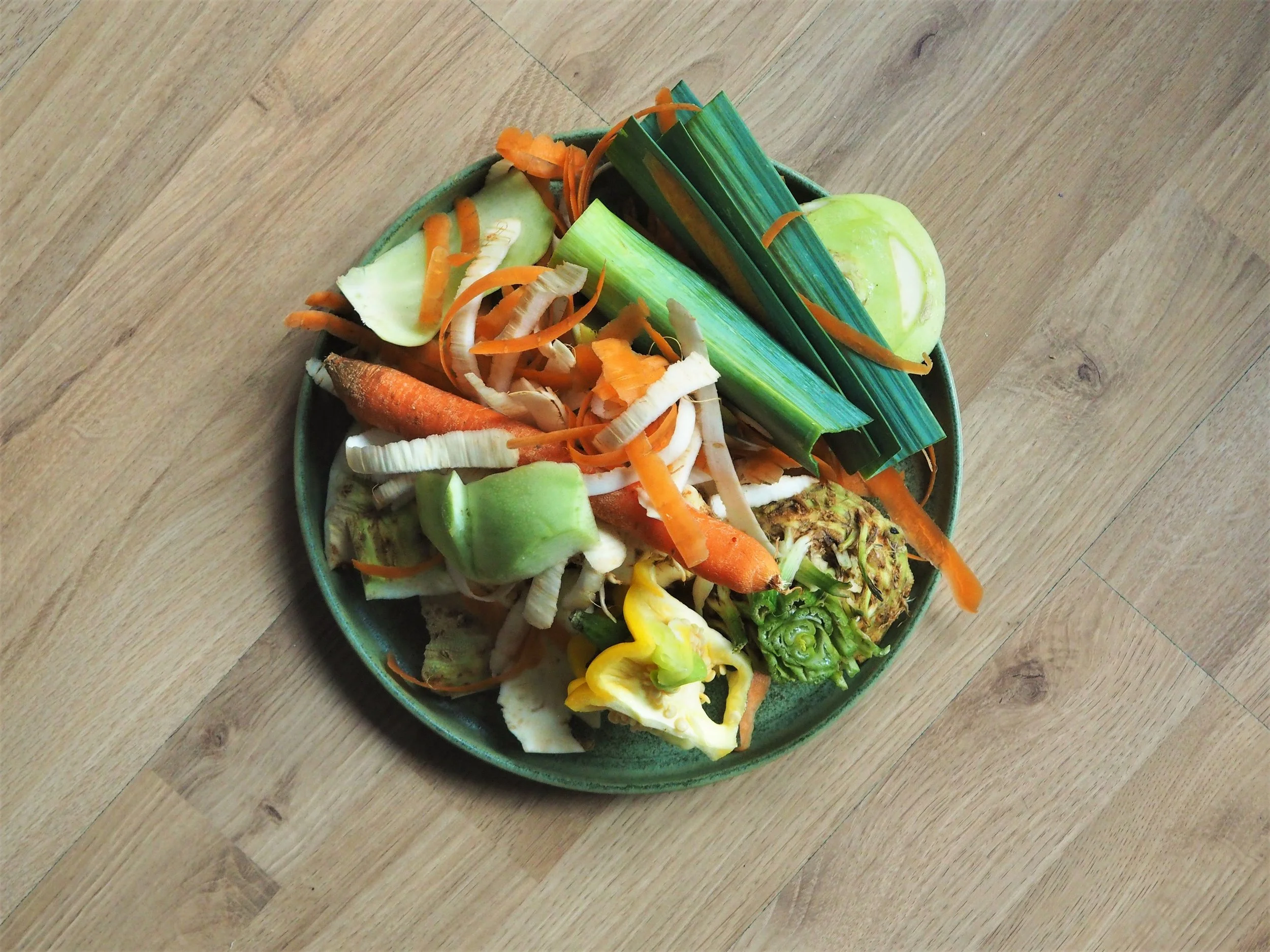
Your trimmings are more expensive than it might seem.
Whether you waste 20kg or 60kg of ingredients in a day, and whether you reduce 50% or 30% of your food waste, we are still talking about tens of thousands of euros/dollars/pounds wasted over a single year.
So, the answer to the question, “How much money is really in your bin?” is “A lot more than you think”.
Food waste is the highest level of inefficiency in the kitchen. It’s unrealistic to achieve 0% waste, but it’s very realistic to reduce 50, 60, or 70% of your food waste.
There is no scenario where designing the food waste out of your system will not reduce your costs. And as well-known research proves, your ROI can be as much as 14€ saved on every 1€ invested in food waste reduction.
So one could say that food waste reduction gives you better returns than investing in the stock market :)